C&L Shows
Azal se Abad tak: a journey between two eternities
2026

Overview
‘Walk gently, heedless traveller’
You walk into a room with empty hands
The room is the world
It holds everything you [didn’t know you] needed—a cypress tree, a rose bush, a pomegranate, a ladder
You don’t see the ladder—but it’s there
It climbs into a cave where Plato sits, letting the sun play the shadow game
You feel a sense of falling
The sky is the only script—a strip of sky—and the whole canvas a vertiginous plain between cliffs
And then blue enters!
Regal, it flings open the door
You walk into the room again
You see a woman wearing the sun like a halo
She is the root of the tree that grows through her heart
Like her baby the tree, like blood her sap
There is a lament being sung like a story
Without words, it wakes you from your sleep
She floats above the bed and you with her
The fruit in her hand is an apple
∞
Arshi Irshad Ahmadzai is back, inviting you on a journey between two eternities.
If you wish to accompany her, make a clearing inside your head.
Pick up the seeds she offers you.
Plant them into your seeing, watch them bloom into insight.
Let door after door after door open…
You’re off, ready for two eternities between a journey—but wait!
Can there be two eternities?
Between
overt & concealed
watery & earthen
threshold & mirror
pendulum & ark
self & not-self
wound & wonder
breaking & healing
ease & unease
order & chaos
Ghalib and Shams
Vincent & Theo
Ekalavya & Drona
now & forever
Ahmadzai shows us:
There can.
∞
In 2021, when the artist had to leave Kabul so precipitately, what she brought with her were the salvaged pieces she placed before us as Qissah-e Kabul (2022). There is something unsettled about that set, even as the geometric frames (or corners thereof) seem determined to hold it together. Even the gold seems subdued as it bravely pins a chair to a floor that isn’t there.
Among all the objects that haunt the ‘storied city’ she left behind, the one that moves me most is a dress—a Bactrian princess’s garment—that gathers Ahmadzai’s palette into a shape so sharp it hurts. It is a dress that waits for a body, stiff and unyielding as the script that patterns its front.
Since then, the ground beneath Ahmadzai’s feet has shifted more than once. From Kabul to India, from India to Weimar, from Germany to New York, she has moved between more than locations. Three years and fourteen months of gestation and creation later, Azal se Abad tak is more than a movement in four parts. It is a series of provocations, a consequence of thought.
You can breeze through it all, letting the magnificence of the colour and compositions knock you sideways or you can pause before lines so delicate you are almost afraid to breathe. Remember, these lines aren’t only on the canvas before you. They are below it, beside it. Ahmadzai’s titles are portals through which you may enter the hidden workings of her world: allegory & myth, history & philosophy, poetry & song. The ampersand is an imposition where each opposition seeps into the other, imperceptible as borders. Is it any wonder that she chooses the ouroboros, that ancient symbol of eternal renewal, as her key visual motif?
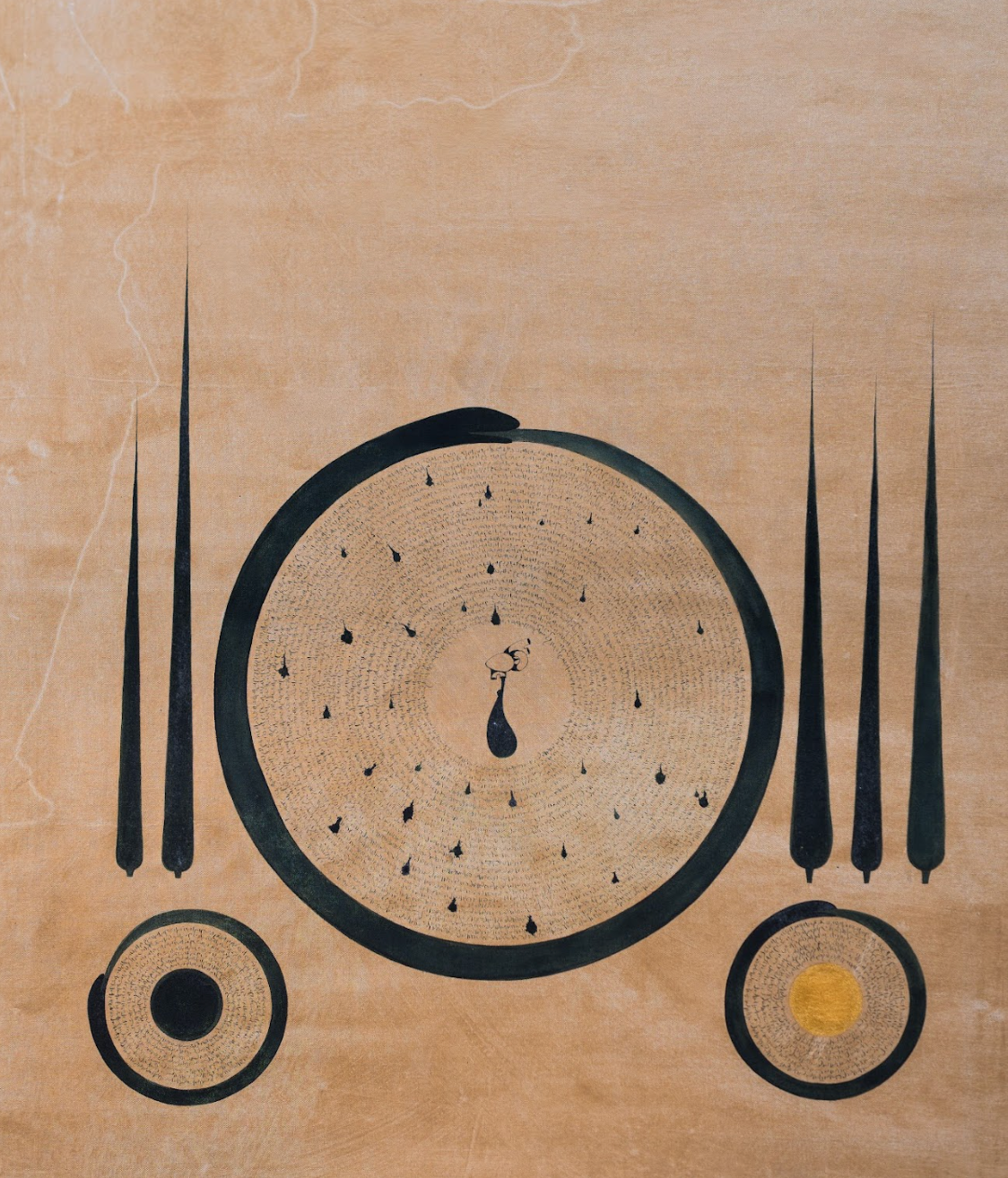
The riffs on this reference are rich and textured, subtle and sensuous. Sometimes the ouroboros is the centre of the universe, a giant mandala; sometimes just a hint of head eating tail; sometimes the outline of the tablet of eternity. There is no hint of rapacity, the snakemouth is blunted, humbled, gentled. Ahmadzai’s ouroboros is human, melancholic, even Dostoevsky is moved to tears when he glances into the darkness where the Ouroboros weeps, consuming and consumed by its own grief. Sometimes it is the idea of an ouroboros that has been spliced in two (‘Amor Fati’) as if having sloughed off the skin of the question—which is the first eternity, which the last?
∞
Arshi shows me her notebook, the one she kept during the making of this series in her New York studio. On the title page she calls herself—with what I recognise as characteristic self-deprecatory humour—‘Ek goonga shaayar, ek nabina naqqash’ (a mute poet, a blind painter).
The book is called Lafz, and inside is the alphabet: alif, be, jeem… kaaf, laam, meem… visualised through ouroborii and hearts—curling in and out of calligraphic joy, swaying, dreaming, dancing, sleeping, separating, entwining daal zaal ain ghain toi zoy hiding one inside the other.
For an artist who paints directly on the canvas without any preparatory sketches, working error into intent—splashes of paint become stars or tears—weaving the natural creases and textures of the canvas into her compositions, this is where I see the artist at play inside her almost-abecedarium, composing poems, offering us the words that animate the series: mohabbat, khamoshi, khayal. Nafas, wajood, ilm. Fana, falsafa, fitrat.
It is a treat, precious beyond words, not only as a glimpse into process, but also because—for the first time in five years—Arshi allows access to the meaning of the script she commits to.
“I am an assassin!” she says with a smile. “I kill words.”
It is a smile that distances pain. If you look closely at her canvases, where the Urdu script plays a vivid, vital role—sometimes sea, sometimes sky, sometimes ground, always more than pattern—it is and it isn’t the Urdu script. Arshi has removed the dots (or nuqta) that make it readable. It’s like putting out their eyes, I think, with a wince. The words become as blind as the reader.
The code that she guards on canvas, she cracks open in the pages of her notebook. She lets us into her poet-self and, through it, illuminates her painter-self, two hearts that beat as one.
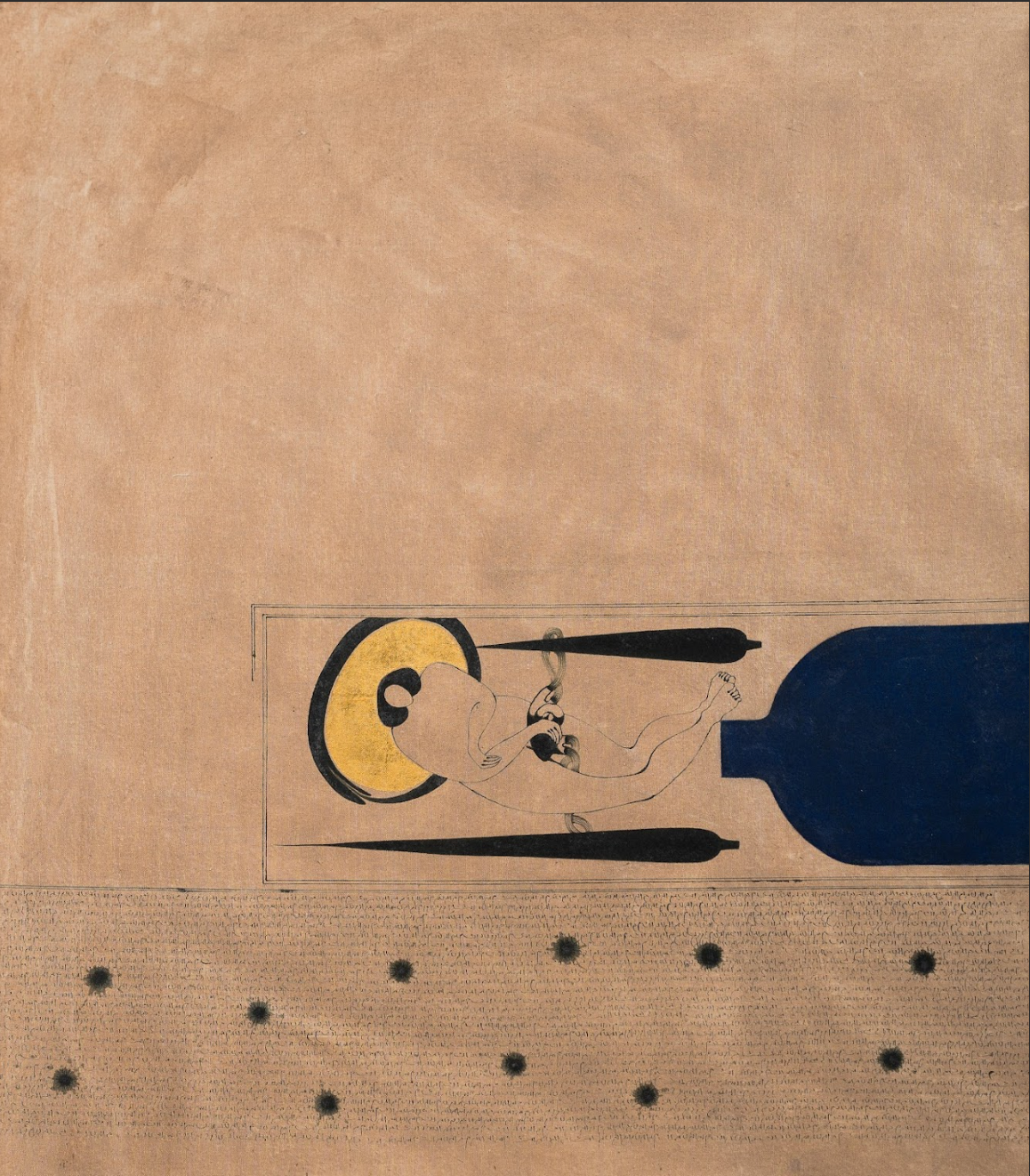
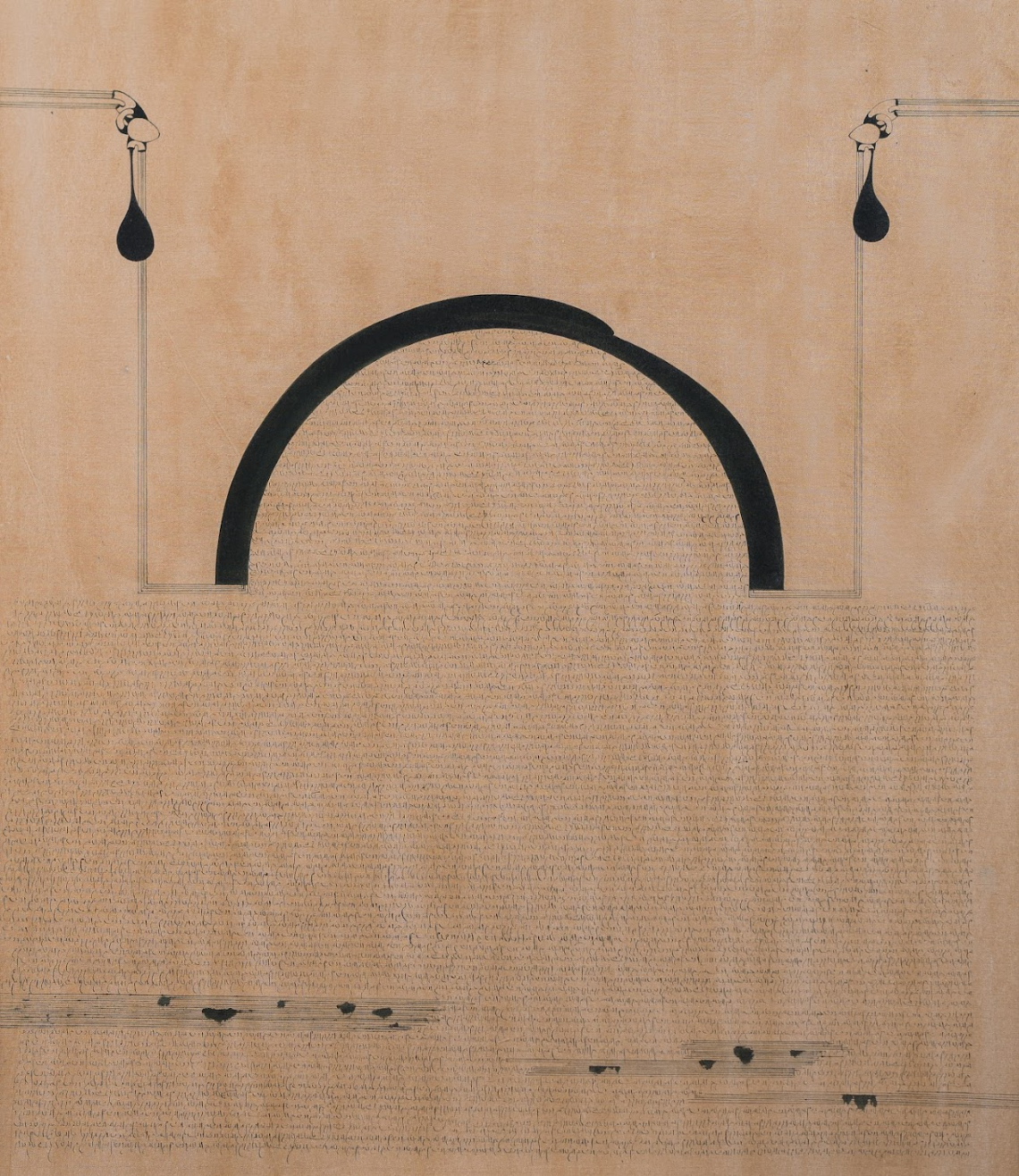
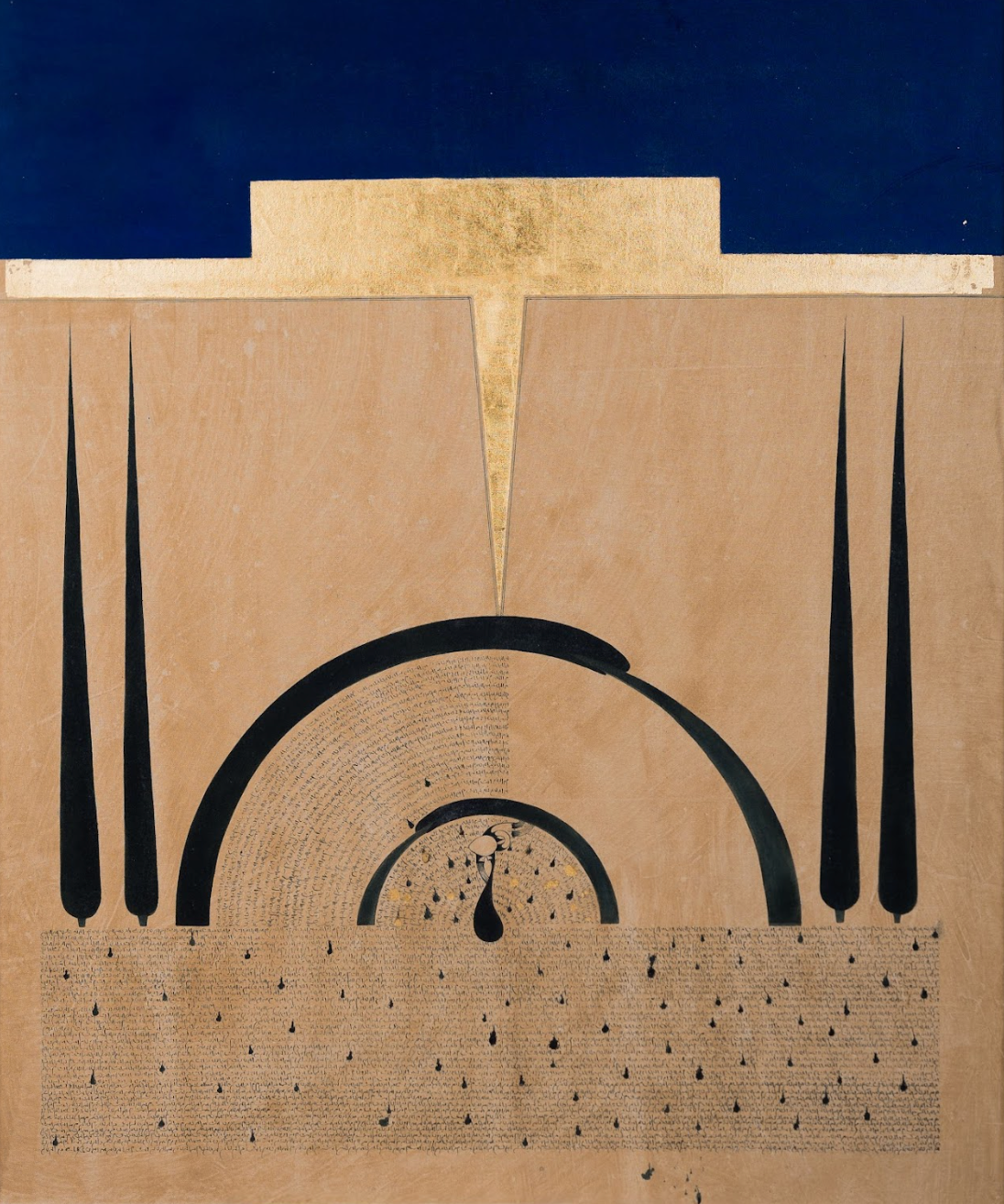
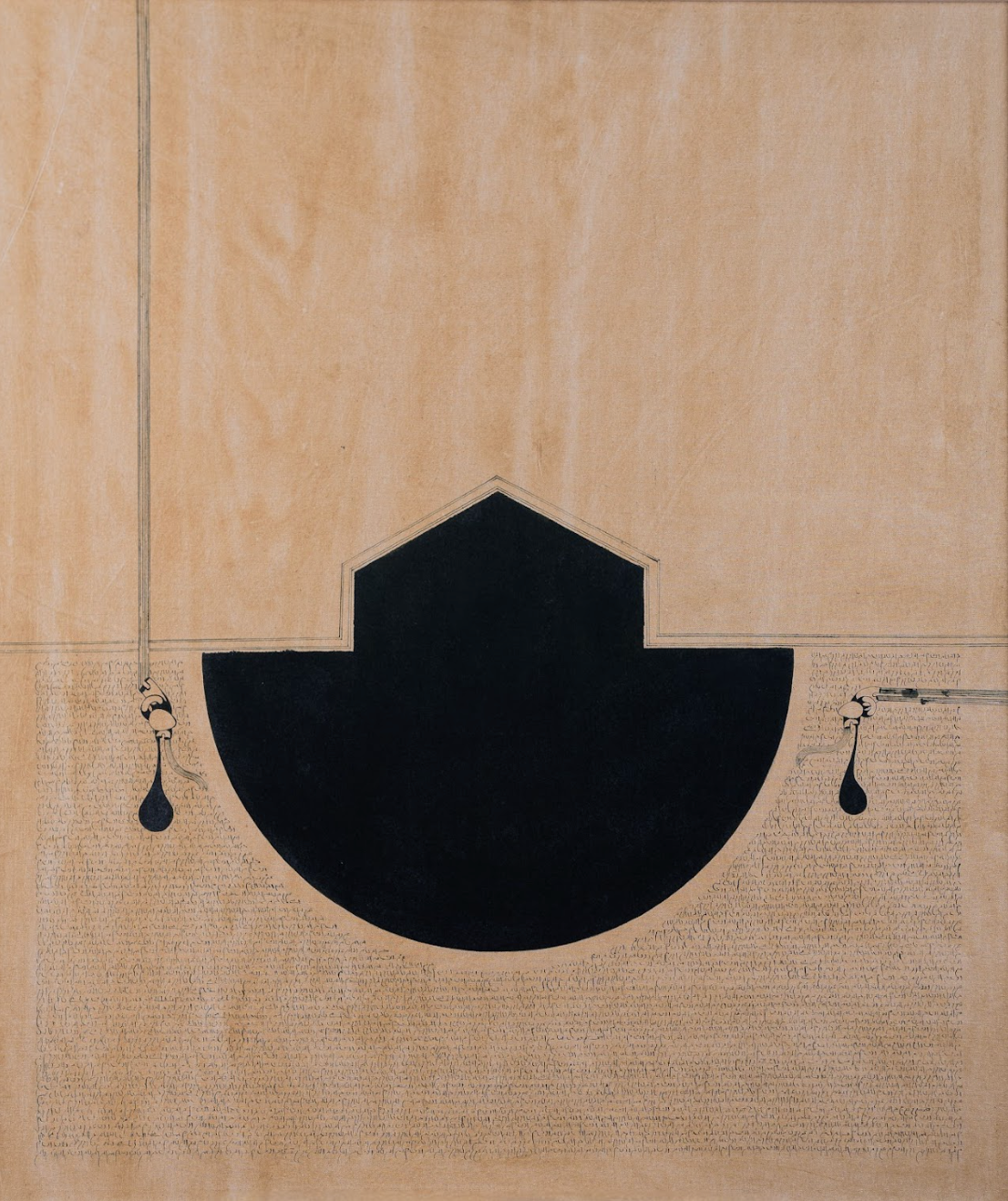
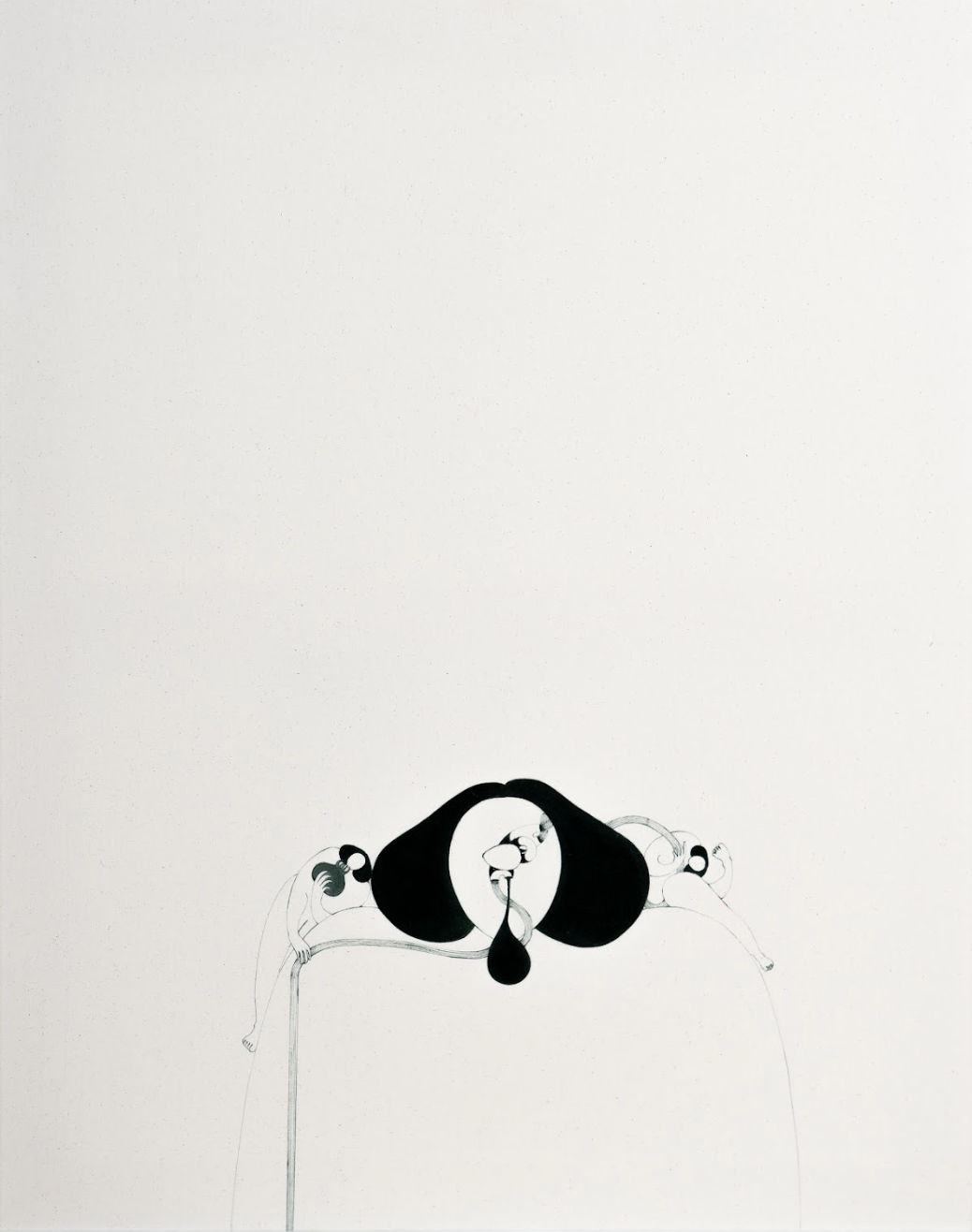
Yet how they long for release! In the painting titled ‘Two hearts wrestled fiercely to break free from the beginning before beginnings’ the only signs of that intense struggle are the smudges that disturb the writing near the bottom of the painting. Lifeblood runs between the lines. The ouroboros has been cut in half, on either side are the two hearts—more Ahmadzai’s signature than recurring motif—like two IV-drips on either side of a hospital bed, to my fanciful eyes.
But fancy is not the artist’s foundation. Like the wise hoopoe in Farīd al-Dīn Aṭṭār’s poem Mantiq al-Tair that she references, Ahmadzai is leading us to the realisation that the self is where the struggle begins. Both out there and in here… A ‘here’ that is knowable in a heartbeat, or never.
And so, to the wandering heart.
“The heart,” she says, “is the protagonist of the series.”
And so it is.
First seen in Qissah-e Kabul, the heart that bled a single drop of ink is back in the new work in a multitude of ways, teasing, confounding, conversing, listening. Infinitely transportable, it arrives speedily—a potent interruption to the hush-a-bye suspension that rocks the cradle that is a half-moon house on a sea of words. It peeps into the frame, shy, almost fleeting. It sits at the bedside of seen/unseen, sowing the gardens of paradise, neither temporal nor eternal. It has personality, this heart, it has comic timing and tragic flair. It makes us wonder: it is really a heart or a thousand and one suns, each glowing like the stories of Shahrazad?
As vein, artery, aorta extend into pipeline, thread, umbilicus, do we hear her, Shahrazad?
∞
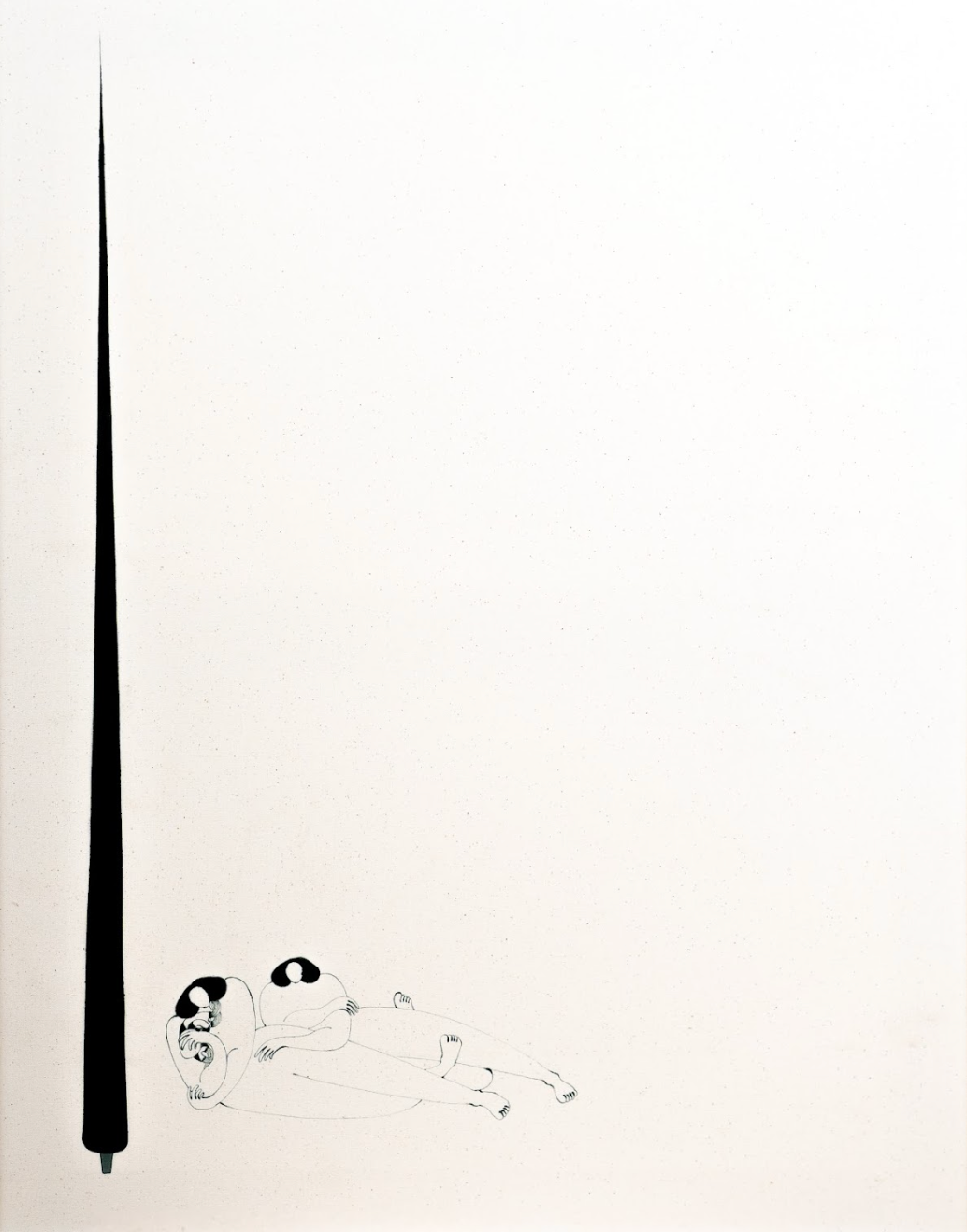
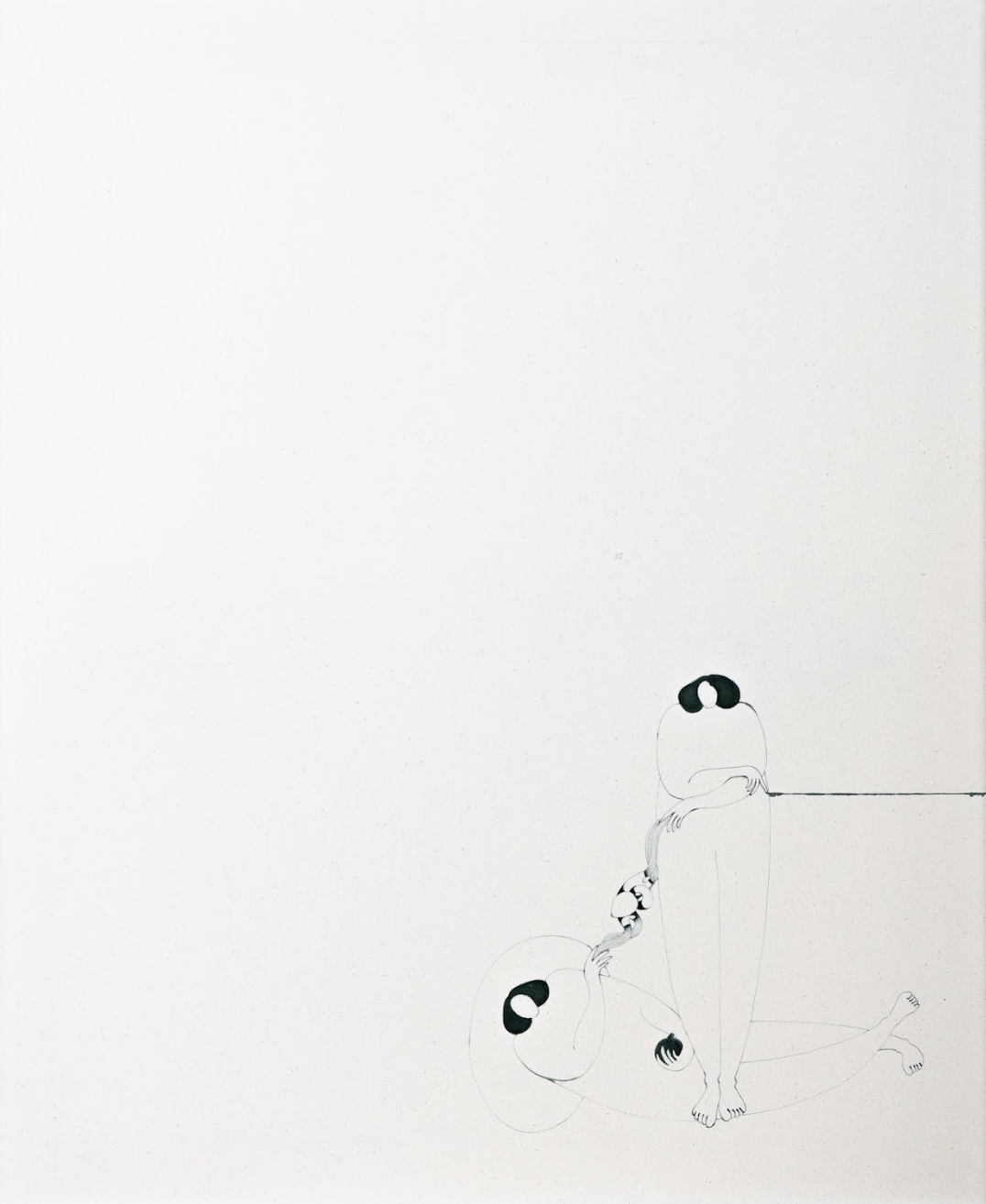
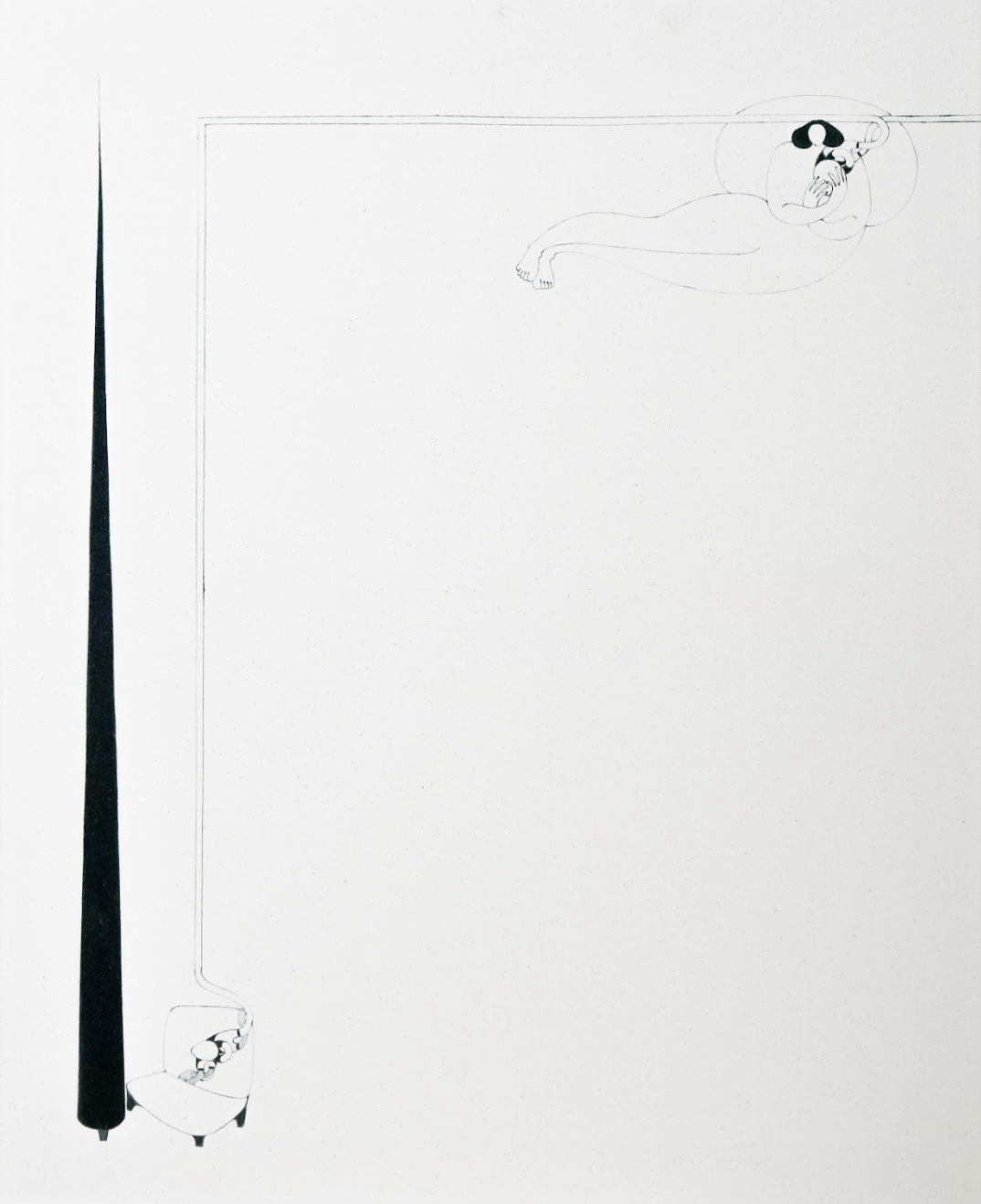
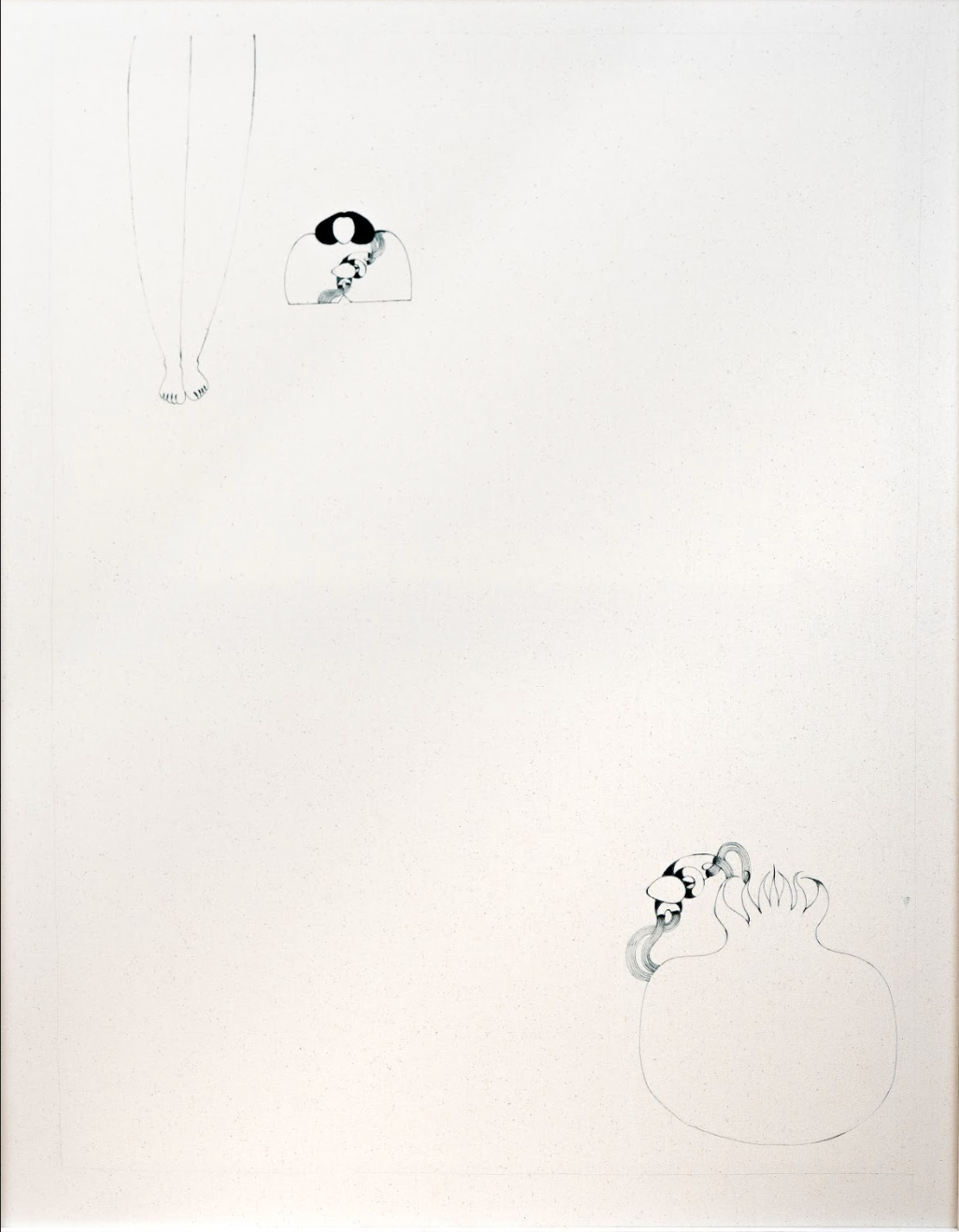
After the monumentality of the works on papier-mâché with Manetti gold on Manjarpat fabric in Parts I and III, the acrylic on permanent press cotton fabric in Part II feels as intimate as the scenes they present. Gathered around a moment between time [Alam/Haal], this is where we see the many manifestations of everymanwomanchildother. Looped and limber, tethered and afloat—their hands hide a cruel loss.
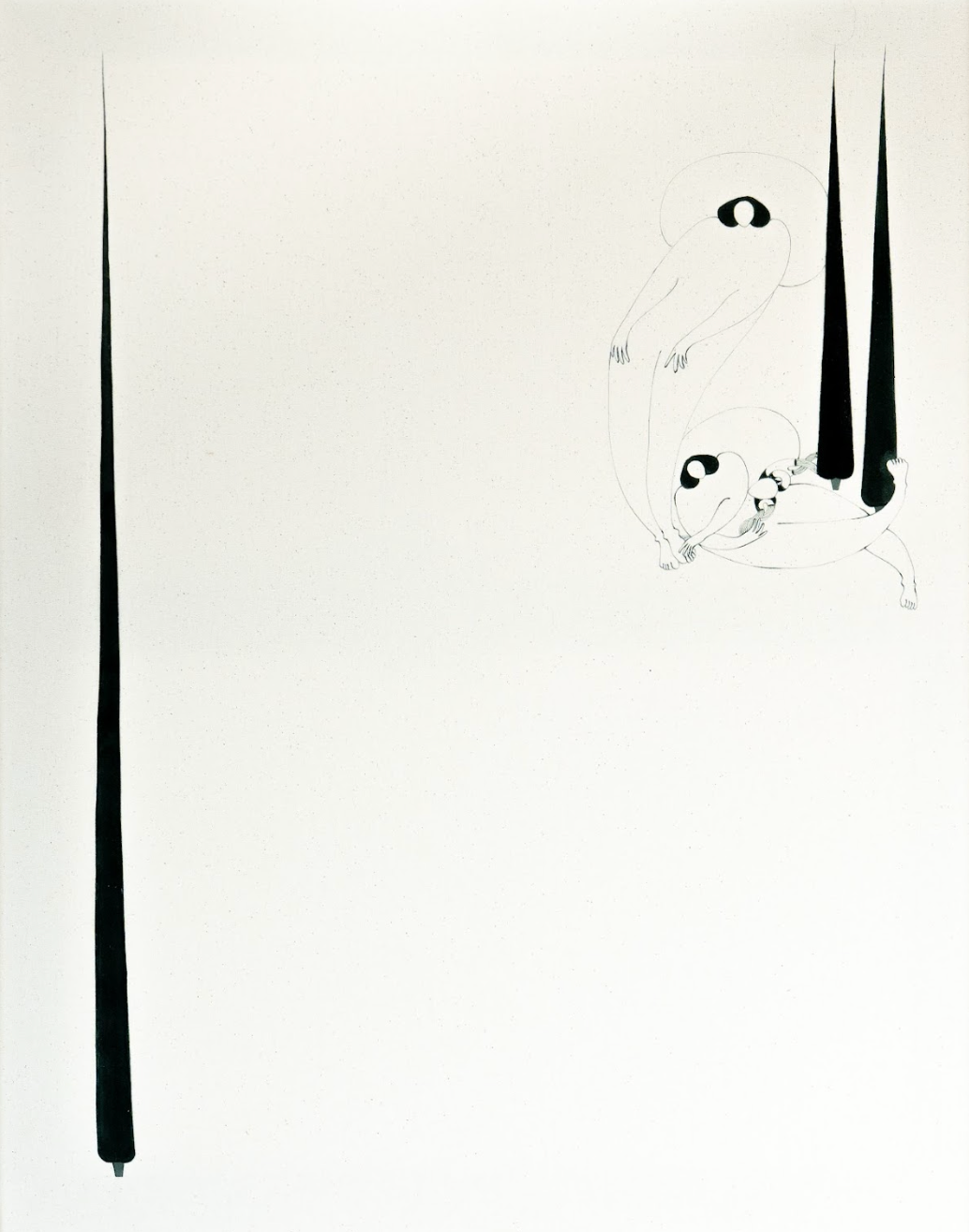
These tenderly rendered figures have a tensile strength that speaks of the artist’s own. You’ll find them pondering (love in the context of Socratic dialogue); pleading (against the caliph al-Muttawakil’s felling of the Cypress of Kashmar, believed to have been planted by Zoroaster himself); protesting (against the unjust, endless incarceration of Umar Khalid); empathising (with Oedipus as the forest cries bitterly for him). Drona has exacted a terrible price and we’re all still paying… But Ahmadzai’s stellar heart will not be beaten down. Slung across a back, left on a chair fastened to a body, it will offer poor Sisyphus the hope of a moment of rest.
If her art is enigmatic, her reading is encyclopaedic. Ahmadzai allies herself with heretic thinkers persecuted for being ahead of their time. Giordano Bruno, the Italian philosopher, astronomer and mathematician, for instance, whose concept of the infinite universe sent him to the stake. Note also the pre-Islamic goddesses Al-Uzza, Al-Lat, Al Manāt whose mythologies spanned heaven & earth, love & war, fertility & fate. Once revered from Petra to Palmyra, these ‘daughters of Allah’ were later decried as symbols of pagan idolatry.
But how did we get here? Where are we headed? And why this infernal hurry? Time stops at the speed of light. The physicist knows this. So does the artist. A gatherer of hours, she places the gliding gears of the mechanism of time between the seen and the unseen. Mark the poise of the captive heart under the blazing spell of the Philosopher’s Stone. If the story won’t turn, the dial will—blue into gold into blue into gold, the equipoise of the estranged.
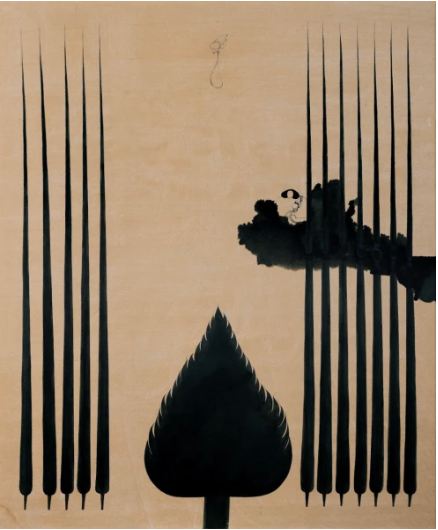
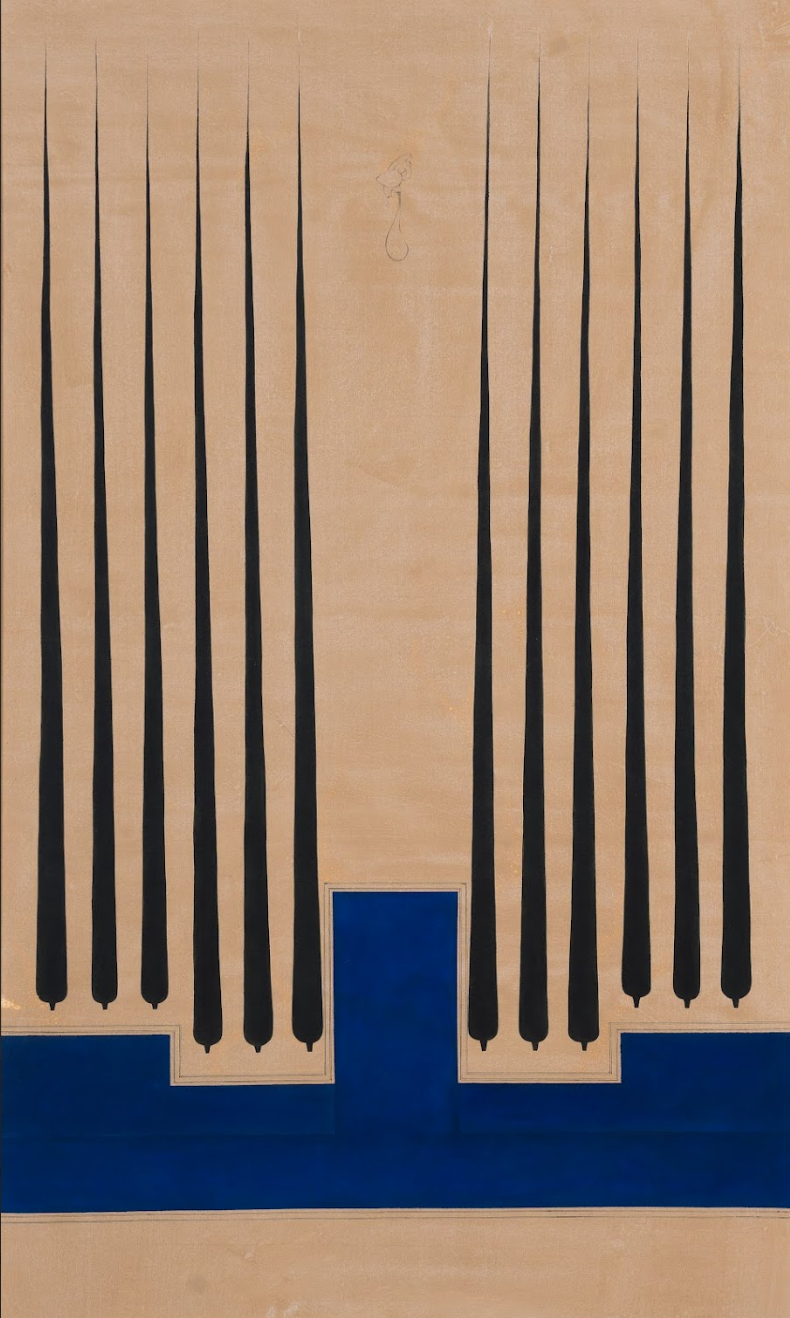
Is the artist a mage with math? Isn’t the overlap of two eternities possible only in a Venn diagram? Are chronos, mythos, topos, eros the four cardinals of the compass we carry inside our heads? Aren’t four invisible quadrants unfixing the space? Eight cypresses aren’t accidental: tip the number 8 on its side and what you see is ∞
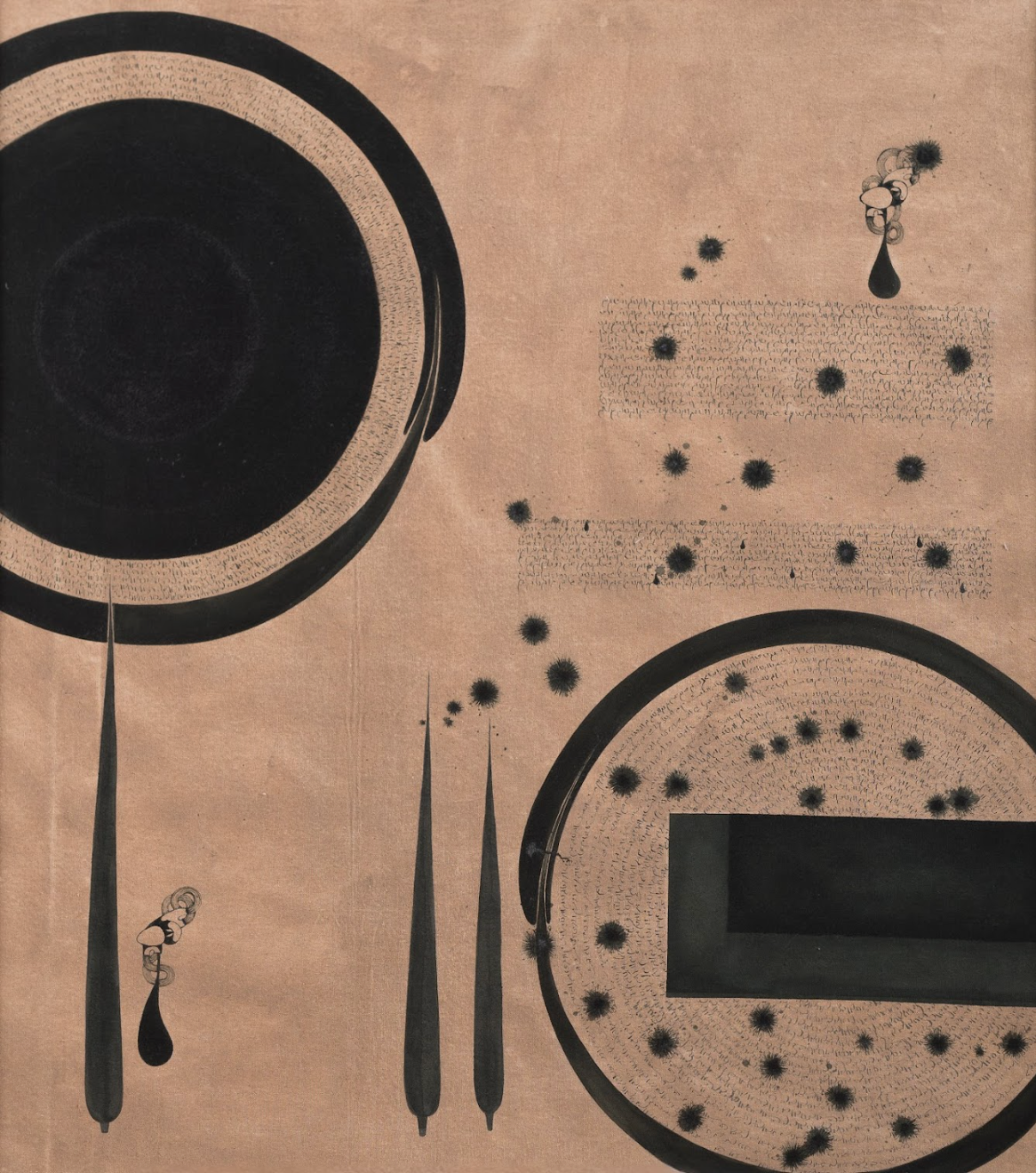
Unafraid of deep fields and deep time, Ahmadzai keeps shifting the needle that points. For me, all the elements of her thinking seem to converge in the painting titled, ‘Come, let us measure the distance between forever and forever’. The ouroboros assumes the rim of a chronometer, the script marks time inside it, the heart waits at the heart of it all, the bodies lie replete in their immeasurable patience.
As I pull back from this busiest of all of Ahmadzai’s pieces, I notice the sleeves of a dress.
And suddenly that’s all I can see—the outline of the dress that had moved me aeons ago—now infinitely alive and peopled, a galaxy streaming away from it.
It’s a cold place: eternity. And when it’s doubled? Twice as much.
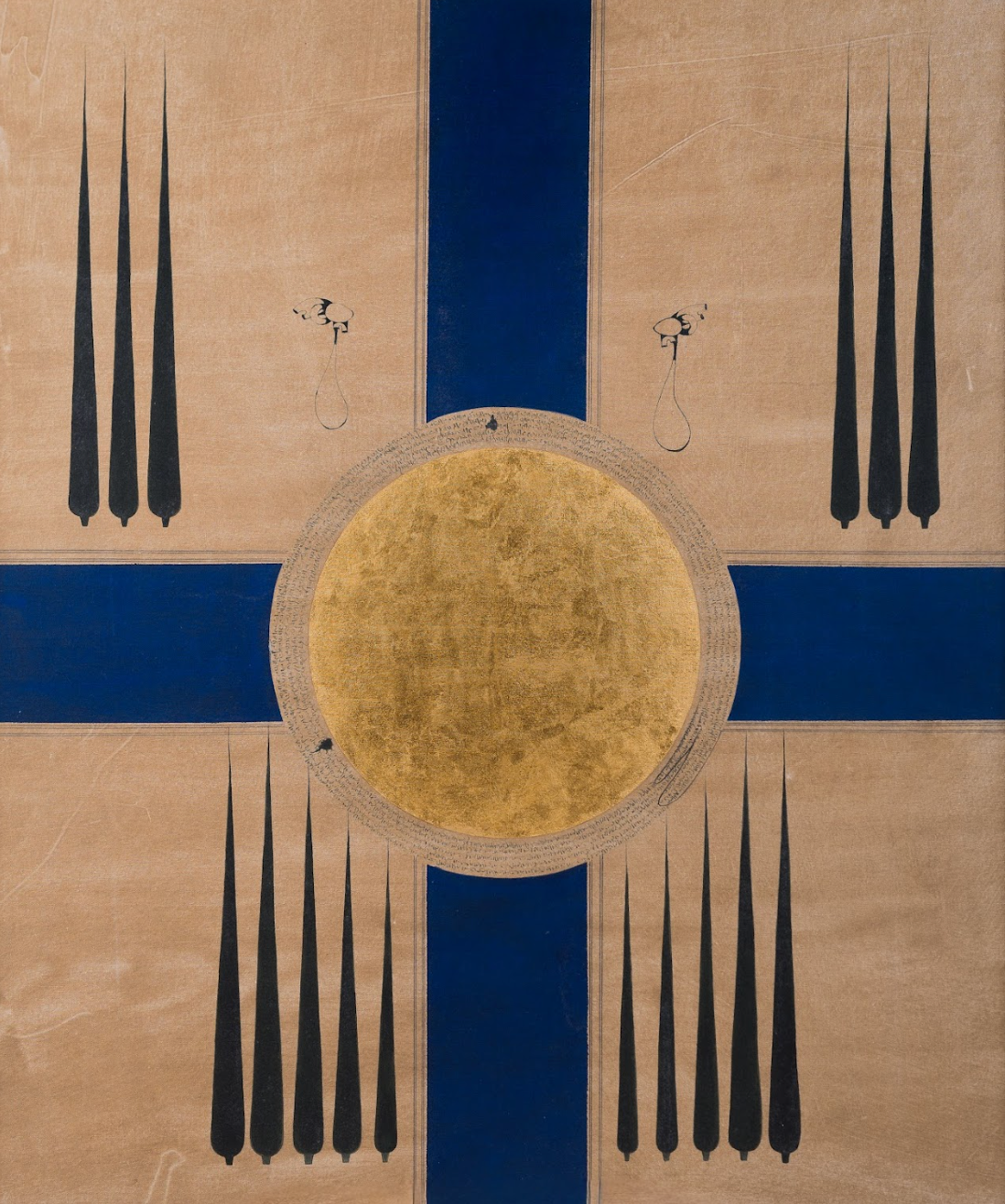
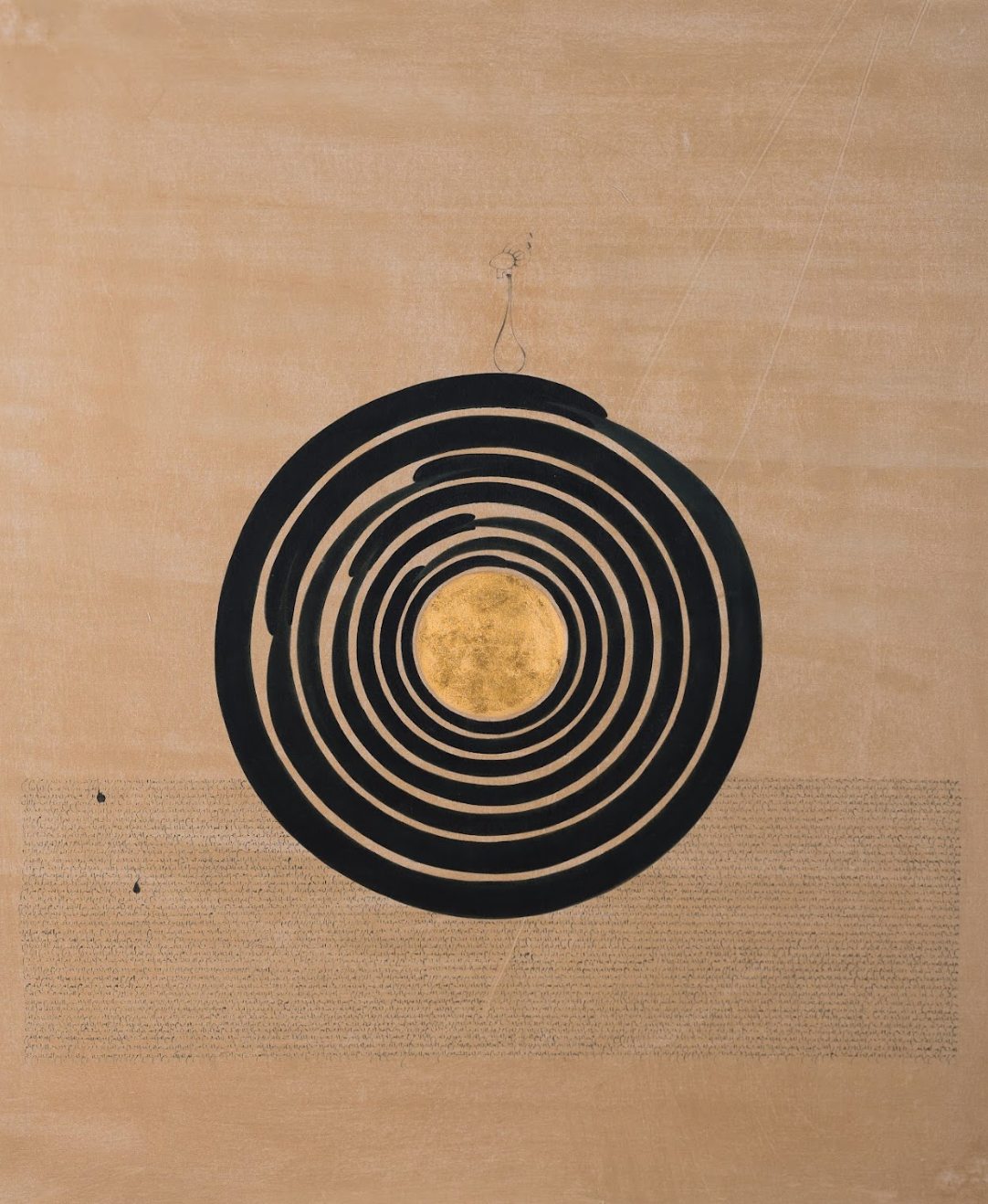
Stand before the painting that is ‘a nod to the abode of God’. You’ll see that here the artist—who self-confessedly prefers asymmetry—has placed the sun at the centre, where it belongs. Mark that here it is Arshi’s blind script that circumscribes that sun.
To circumscribe something is to limit its size, activity or range, but the range of influence of the Latin ancestors of circumscribe knows no bounds. Circumscribe comes via Middle English from the Latin verb circumscribere (which roughly translates as ‘to draw a circle around’), which in turn comes from circum-, meaning “circle,” and scribere, meaning “to write or draw.”
Only one who has faced circumscription can fold it into its opposite.
Emblematic and opulent, this painting feels like it heralds a greater truth than the two little hearts hovering mid-field can comprehend. What they see is what they can swear by: ‘eternity warming itself as it circled the sun’.
How can we see what is not there?
The dare of the unanswerable question.
Halt
We’ve stepped outside both eternities.
Abruption like a frozen lake.
All colour but blue has fled.
On raw canvas we face:
The Oneness of Being,
the First and the Last,
the without and the within
What lies beyond this absolute?
Within the silent soundscape of an originary hymn, we find a spinning wheel of ourobourii. Against the universal riddle of the Nasadiya Sukta, the artist sets her closing proposition: the primal tear is a tear in time.
/
Breathe deep. The neverending story has just begun.
SAMPURNA CHATTARJI
January 2026